Today, I am doing a brief response on an article by Palmquist; he stresses, as his key ideas, the importance of organization on websites and that consistent, simple layouts are the best to use for websites.
As a response, I have posted two links to two separate websites; the first is a link to the online magazine Slate, which is very well organized and has a consistent, defined layout in the form of an article bar, sections, and separate use of colors; the other link is to the self-proclaimed World's Worst Website, which uses its horrendous layout as a means to teach prospective site managers what not to do when designing a website.
Here they are, below; look at the second one at your peril:
http://www.slate.com/
http://www.angelfire.com/super/badwebs/
I know this doesn't have much to do with older media, but it provides a good contrast, doesn't it?
Friday, March 19, 2010

Wednesday, March 17, 2010
Happy St. Patrick's Day
In honour of the closing hours of St. Patrick's Day, I'm putting up a vid by the Dubliners of "Rocky Road to Dublin", a traditional Irish song last heard in the 2009 film Sherlock Holmes:
Happy St. Paddy's Day, folks; enjoy your green beer.
Happy St. Paddy's Day, folks; enjoy your green beer.
Thursday, February 18, 2010
FirstSounds.org
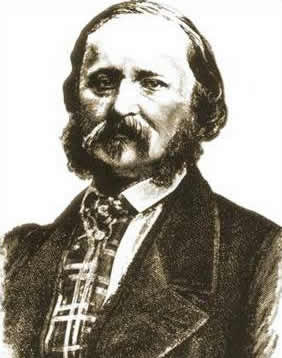
Today, I'd like to delve into some of the oldest playable audio recordings known to researchers: The phonautograms of Édouard-Léon Scott de Martinville, the first of which were recorded in 1859.
I'll let Wikipedia explain:
The device consisted of a horn or barrel that focused sound waves onto a membrane to which a hog's bristle was attached, causing the bristle to move and enabling it to inscribe the sound onto a visual medium. Initially, the phonautograph made recordings onto a lamp-blackened glass plate. A later version (see image) used a medium of lamp-blackened paper on a drum or cylinder. Another version would draw a line representing the sound wave on a roll of paper. The phonautograph was a laboratory curiosity for the study of acoustics. It was used to determine the frequency of a given musical pitch and to study sound and speech; it was not understood at that time that the waveform recorded by the phonautograph was in fact a recording of the sound wave that needed only a playback mechanism to reproduce that sound.
The audio below is a recording of the song Au clair de la lune, probably the best known of all Scott de Martinville's phonautograms:
I'll let Wikipedia explain:
The device consisted of a horn or barrel that focused sound waves onto a membrane to which a hog's bristle was attached, causing the bristle to move and enabling it to inscribe the sound onto a visual medium. Initially, the phonautograph made recordings onto a lamp-blackened glass plate. A later version (see image) used a medium of lamp-blackened paper on a drum or cylinder. Another version would draw a line representing the sound wave on a roll of paper. The phonautograph was a laboratory curiosity for the study of acoustics. It was used to determine the frequency of a given musical pitch and to study sound and speech; it was not understood at that time that the waveform recorded by the phonautograph was in fact a recording of the sound wave that needed only a playback mechanism to reproduce that sound.
The audio below is a recording of the song Au clair de la lune, probably the best known of all Scott de Martinville's phonautograms:
If that wasn't readily discernible (or energetic) enough for you, here's a later recording, from September 1860, of the inventor himself, singing an abbreviated version of "La Chanson de l'Abeille":
Until next time, I hope you've enjoyed this enstallment.
Tuesday, February 16, 2010
A Day in the Life
 I read the news today, oh, boy...
Most of you, out there, are probably wondering what in the blue hell my blog title has to do with the content on it, considering the music on here in no way describes my daily life.
Well, here's the namesake for it, by the Beatles, from 1967:
Rather appropriate, wouldn't you think? Hope you enjoy it.
Saturday, February 13, 2010
Nick Lucas
Yesterday, I wrote about Nick Drake, the English musician from the '70s whose work has singularly inspired so many; however, it's not just this aspect of old culture that I appreciate.
Today, let me introduce you to Nick Lucas:
As you can see, the man could still play as he was in his prime as late as his 80s! Clearly, Nick Lucas, as with Nick Drake, needs to be appreciated by the greater listening public; his songs may be old, but they still ring true with emotion.
Today, let me introduce you to Nick Lucas:

This singer and guitarist was of an older generation than Nick Drake, yet his work is still appreciable today; I'll show you by demonstrating two videos of him.
The first is one of his first appearances on film, in 1929, debuting the song "Tiptoe Through the Tulips" from Gold Diggers of Broadway:
The second is a video of him playing the same song, as well as Irving Berlin's "What'll I Do?" (best known from The Great Gatsby), at his 80th birthday party in 1977:
As you can see, the man could still play as he was in his prime as late as his 80s! Clearly, Nick Lucas, as with Nick Drake, needs to be appreciated by the greater listening public; his songs may be old, but they still ring true with emotion.
Friday, February 12, 2010
Nick Drake
I'm not really interested in most new culture, and I think this blog will reflect that. I enjoy some obscure films and music; one of these we'll be talking about today is a musician you've probably never heard of, Nick Drake. 

Nick Drake was... well, I'll let Wikipedia explain: http://en.wikipedia.org/wiki/Nick_Drake
Now that you've read that, I'll let you listen to one of his best songs, River Man, from his first album:
Now, here is one of his last songs, which is one of my favorites by him:
I hope you've enjoyed the music; its tale (as well as its teller's) is sad, but its melodies will linger in your mind for twice as long...
I hope you've enjoyed the music; its tale (as well as its teller's) is sad, but its melodies will linger in your mind for twice as long...
Tuesday, January 26, 2010
First Post...
Hello, world! I'm Matt!
You may not know me, now, but I hope you will, soon...
Till then, have a good one, folks.
You may not know me, now, but I hope you will, soon...
Till then, have a good one, folks.
Subscribe to:
Posts (Atom)